
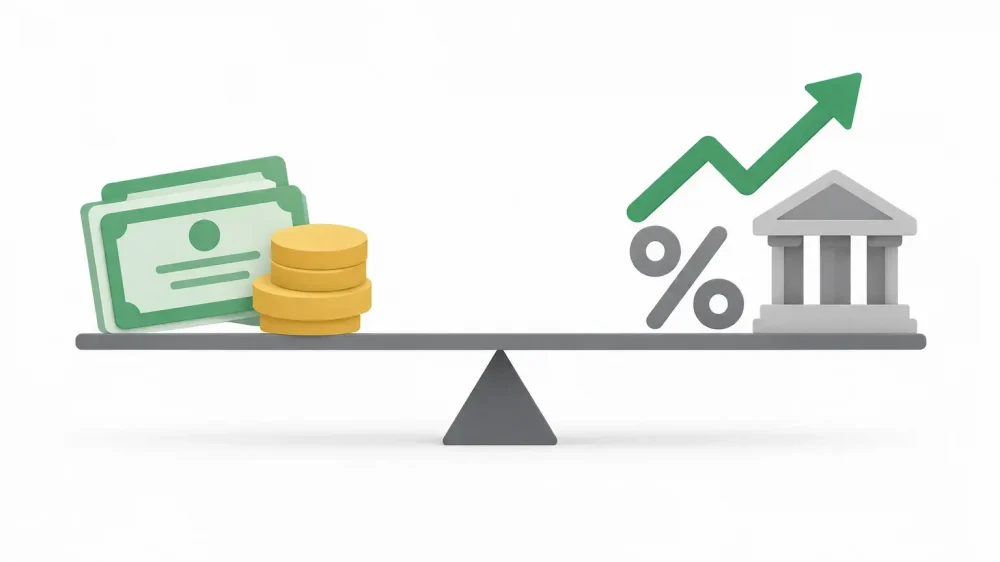
Bond market headlines in 2026 can make it seem as though the market is moving in opposite directions at the same time: some analysts point to the renewed attractiveness of bonds, while others warn about pressure on yields from heavy government borrowing and rising corporate debt, including financing linked to artificial intelligence infrastructure. In reality, these developments can occur simultaneously because bond prices and yields are shaped by a combination of inflation, interest rates, new debt issuance, economic growth expectations, and investor attitudes toward risk.
What’s actually happening in the bond market right now
The bond market in 2026 is caught between two major forces: expectations for easier monetary policy and the need to absorb substantial amounts of new government and corporate debt.
After a period of high interest rates, bonds have become more attractive to many investors because they offer higher current yields than they did during the era of near-zero rates.
This is particularly important for investors seeking regular interest income. Earning a meaningful yield no longer necessarily requires moving into the riskiest segments of the debt market.
However, higher yields do not exist in isolation.
Governments continue to finance substantial budget deficits by issuing new bonds. Corporations are also raising capital for investment, acquisitions, refinancing existing debt, and major technology projects.
The more new bonds enter the market, the more capital is required to buy them.
If demand does not increase alongside supply, issuers may need to offer investors higher yields. This can put downward pressure on the prices of existing bonds.
At the same time, expectations of lower policy rates can push in the opposite direction. If investors believe future interest rates will be lower, previously issued bonds with attractive fixed coupons may become more valuable.
That is why statements such as “bonds are attractive again” and “yields remain under pressure” are not necessarily contradictory.
They simply describe different forces acting on the same market.
Key factors currently driving yields
Bond yields are shaped by expectations for interest rates, inflation, economic growth, borrowing volumes, and the credit risk of individual issuers.
The most important factors include:
- Central bank policy. Expectations about increases or decreases in policy rates have a particularly strong influence on short-term bonds. If markets expect rates to fall, short-term yields often begin pricing in those expectations before the actual policy change occurs.
- Inflation. Bond investors receive predetermined cash payments, so higher inflation reduces the real purchasing power of those payments. The higher expected inflation becomes, the more yield investors generally demand as compensation.
- Government borrowing. Large budget deficits require governments to issue more debt. Greater supply can put upward pressure on yields, particularly if investors demand additional compensation to absorb large volumes of new bonds.
- Economic growth. A strong economy can support higher interest rates and reduce the likelihood of rapid monetary easing. A sharp economic slowdown, by contrast, can increase demand for high-quality bonds as relatively defensive assets.
- Credit risk. Corporate bond yields depend not only on underlying government rates but also on the probability that a company will meet its obligations. The greater the perceived risk, the larger the credit spread investors generally demand.
These factors constantly interact.
For example, a central bank may cut its short-term policy rate without producing an equally large decline in long-term government bond yields.
If investors are simultaneously concerned about future inflation or heavy government borrowing, they may continue demanding relatively high yields on long-term debt.
That is why the statement “the central bank is cutting rates” is not enough by itself to predict what will happen across the entire bond market.
Why government and corporate borrowing keeps rising
Growth in the debt market reflects enormous demand for capital from governments and companies, while the expansion of AI has created another major source of financing needs within the corporate sector.
Government borrowing is primarily driven by the difference between public spending and government revenue.
When a government spends more than it collects through taxes and other sources, the difference is typically financed by issuing debt.
If deficits remain substantial, governments must issue new bonds not only to refinance maturing obligations but also to fund additional spending.
The corporate debt market works differently.
Companies issue bonds to finance investment, purchase equipment, acquire other businesses, repurchase shares, refinance existing obligations, and expand operations.
The development of artificial intelligence has increased capital requirements in certain parts of the economy.
Data centers, computing infrastructure, specialized chips, energy capacity, and network equipment require enormous upfront investment. Large technology companies can finance some of these projects through internal cash flow, but debt markets also provide access to substantial amounts of capital.
Rising corporate debt is not automatically a negative signal.
The important questions are who is borrowing, under what terms, and for what purpose.
A company with strong cash flow that borrows to finance productive investment is in a very different position from a weak business that continually takes on new debt to cover operating losses.
How to read yield movements step by step
To interpret a change in yields correctly, first identify which part of the market is moving and then determine whether expectations for interest rates, inflation, economic growth, or credit risk have changed.
A useful approach involves four steps:
- Identify the bond’s maturity. Movements in two-year and ten-year government bond yields can reflect very different expectations. Short maturities are more closely tied to near-term central bank policy, while longer maturities also incorporate long-term expectations for inflation, economic growth, and fiscal policy.
- Check whether expectations for rates and inflation have changed. New inflation, employment, or economic growth data can quickly alter the expected path of interest rates and therefore affect bond valuations.
- Look at the supply of new bonds. Large government auctions or waves of corporate issuance can temporarily change the balance between supply and demand. It is particularly useful to watch how easily the market absorbs new debt.
- Separate the underlying rate from the credit spread. If corporate bond yields rise, determine why. Government bond yields may have increased while perceptions of the company’s risk remained unchanged. But if credit spreads are also widening, investors may be becoming more cautious about the issuer or the corporate sector more broadly.
It is important to remember the fundamental relationship between a bond’s price and its yield.
When the price of an existing bond falls, its yield rises. When its price rises, its yield falls.
Suppose a newly issued government bond offers a higher interest rate than a similar bond issued previously. Investors will be less interested in the older bond unless its price falls enough to make its effective yield competitive.
That is why rising market interest rates generally put downward pressure on the prices of previously issued bonds.
Common misconceptions about the 2026 bond market
Many misunderstandings come from trying to reduce a complex debt market to a single rule, such as “rates are falling, so all bonds should rise.”
The first misconception is that a reduction in the central bank’s policy rate automatically causes yields on all bonds to fall by the same amount.
It does not.
A central bank directly controls only certain short-term interest rates. Long-term bond yields are determined by the market and incorporate expectations about future inflation, economic growth, fiscal policy, and other risks.
The second misconception is that a high yield is automatically attractive.
A higher yield does increase potential interest income, but investors need to understand why the yield is high.
Sometimes it simply reflects the general level of interest rates. In other cases, investors are demanding additional yield because the risk of default is higher.
The third mistake is treating all bonds as defensive assets.
Short-term government securities, long-term government bonds, investment-grade corporate debt, and high-yield corporate bonds can react very differently to the same market environment.
For example, lower-rated corporate bonds can behave more like risky assets than traditional defensive investments during an economic crisis.
Another misconception is that rising government debt guarantees an immediate collapse in the bond market.
Heavy borrowing can certainly affect yields, but the outcome depends on many factors, including investor demand, inflation, economic growth, monetary policy, and confidence in the issuer.
Finally, investors sometimes assume that an attractive current yield guarantees a particular total return.
But if a bond is sold before maturity, changes in its market price can have a substantial impact on the investor’s actual return.
What this actually means for individual investors
For individual investors, the key lesson is not to predict the next move in interest rates, but to choose bonds whose maturity, credit risk, and interest-rate sensitivity match the objectives of the portfolio.
The first step is to determine what role bonds are supposed to play.
If the money may be needed relatively soon, preserving liquidity and limiting sensitivity to interest-rate changes may be more important than maximizing potential yield.
If the investment horizon is considerably longer, longer-duration bonds may serve a different purpose, although their prices are generally more sensitive to changes in interest rates.
This is where duration becomes particularly important.
The higher the duration of a bond or bond fund, the more its price will generally respond to changes in market interest rates. As a result, two funds offering similar current yields can carry very different levels of interest-rate risk.
Credit quality should be evaluated separately.
The additional yield available from corporate bonds can be attractive, but it represents compensation for taking additional risk. Investors need to determine whether that risk is consistent with the role bonds are intended to play in their portfolios.
For some objectives, a bond ladder can be useful. This involves spreading investments across bonds with different maturity dates.
As individual bonds mature, the proceeds can either be used or reinvested at prevailing interest rates. This reduces dependence on investing all available capital at a single point in time and at a single interest rate.
Bond funds provide another approach by offering diversification and simpler management, but they do not have one fixed maturity date for the entire portfolio in the way an individual bond does.
Finally, investors should avoid building a strategy entirely around headlines.
A report that yields are rising can be negative for the current prices of existing bonds, but it also means that new investments may offer higher potential interest income.
Falling yields, by contrast, may increase the value of existing bonds while reducing the income available when money is later reinvested.
This dual effect explains many of the apparent contradictions in bond market news.
In 2026, bonds can once again play an important role in portfolios because of the yields available, but investors need to distinguish between interest-rate risk, credit risk, and inflation risk, consider maturity and duration, and avoid treating the entire bond market as a single asset.
The key question is not whether the bond market is currently “good” or “bad,” but which part of the debt market best matches a specific financial objective, investment horizon, and acceptable level of risk.