
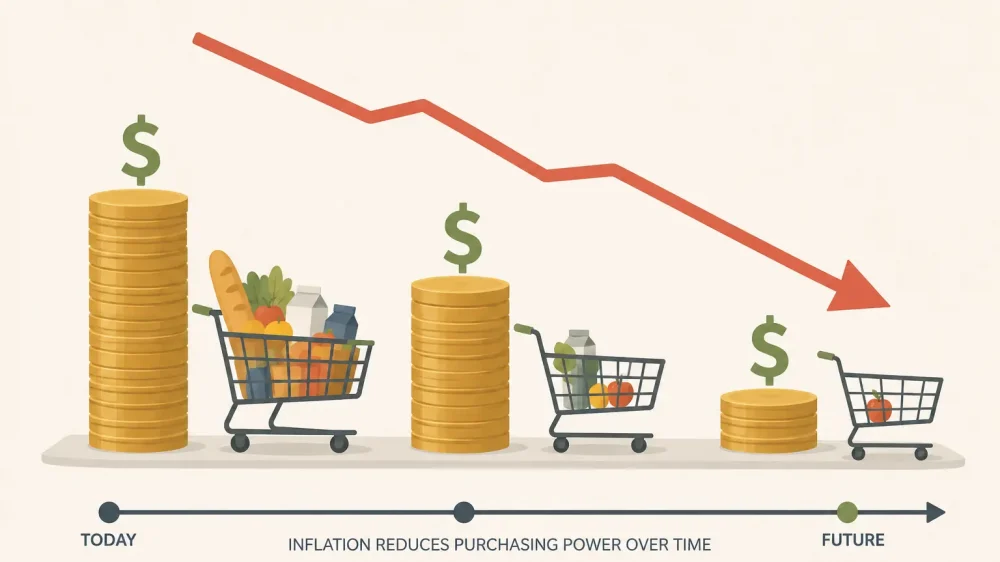
Inflation can reduce wealth without changing the number displayed in a bank account: the balance may stay the same while the amount of goods and services it can buy steadily falls. Unlike a sudden market loss, inflation often works gradually and is therefore easier to ignore. Waiting for prices to “settle down” can itself be costly because purchasing power lost during that period does not automatically return when the inflation rate eventually declines.
How inflation actually erodes wealth over time
Inflation damages wealth by reducing purchasing power, which means money must grow at least fast enough to offset rising prices before it produces a positive real return.
Suppose someone keeps $50,000 in cash for several years. If the account pays little or no interest, the numerical balance may remain close to $50,000. That can create a sense that the money has been preserved.
But its economic value has changed.
If the general price level rises, the same $50,000 buys fewer groceries, services, trips, household goods, and other necessities than it did when the money was originally saved.
This is the difference between nominal and real value.
A nominal return measures how much an investment increased in monetary terms. A real return considers inflation as well. If an investment earns 4% while inflation is 3%, its approximate real gain is only around 1% before considering taxes and other costs.
The effect becomes more significant over long periods because inflation compounds.
At an average inflation rate of 3%, something costing $100 today would cost roughly $134 after ten years if that rate persisted. At 5%, the same item would cost about $163.
Inflation also affects different households differently.
Official inflation measures represent broad baskets of goods and services, but an individual’s actual spending pattern may be very different. Someone who spends heavily on housing, healthcare, education, or energy may experience price increases that differ substantially from headline inflation.
This makes inflation unusual among financial risks. There is rarely a single moment when someone can point to a statement and see the loss. Instead, purchasing power gradually disappears.
Practical steps to protect your money from inflation
Protecting money from inflation usually requires a combination of sufficient liquidity, productive investments, controlled expenses, manageable debt, and income that has the potential to rise over time.
A practical approach can include:
- Keep an emergency reserve without holding excessive idle cash. Cash remains important for short-term expenses and unexpected events, even though it may lose purchasing power. The goal is not to eliminate cash but to distinguish money needed for liquidity from money intended for long-term growth.
- Make idle cash work harder. Savings accounts, money-market instruments, short-term government securities, and similar options may offer income while maintaining relatively high liquidity. Available rates and risks vary, so the appropriate choice depends on when the money will be needed.
- Invest long-term capital according to your time horizon. Diversified investments in productive assets can provide greater long-term growth potential than cash, although they also involve volatility and the possibility of losses.
- Review expensive variable-rate debt. Inflationary periods can coincide with higher interest rates, making some forms of borrowing more expensive. Understanding which debts have fixed versus variable rates can prevent unexpected increases in payments.
- Work on the income side as well as the investment side. Career development, pricing changes for business owners, additional skills, and new income sources can help household earnings adjust as living costs rise.
These measures serve different purposes.
An emergency fund is designed primarily for liquidity and stability, not maximum returns. Long-term investments are intended to build wealth but may fluctuate significantly. Debt management reduces financial vulnerability, while income growth addresses inflation directly through higher cash inflows.
Trying to make one asset perform all of these functions usually creates unnecessary risk.
Which assets tend to hold up best during inflationary periods
No asset provides perfect inflation protection in every environment, so resilience usually comes from combining investments with different sources of return rather than betting everything on a single “inflation hedge.”
Equities are one important example.
Businesses can sometimes respond to higher input costs by raising prices. Companies with strong brands, healthy margins, low capital requirements, and meaningful pricing power may be better positioned to preserve profitability during inflation.
However, stocks are not guaranteed to rise when inflation increases.
High inflation can lead to higher interest rates, lower valuations, weaker consumer demand, and greater economic uncertainty. As a result, equities may still experience significant losses even if they offer attractive long-term growth potential.
Inflation-linked government bonds are more directly connected to changes in consumer prices. Depending on the country and instrument, their principal or payments may adjust according to an inflation measure.
They can therefore serve a more explicit inflation-protection role, although their market prices can still fluctuate and their tax treatment may vary.
Real estate is another frequently discussed option.
Property values and rents can increase over time as prices rise, but real estate is affected by local supply and demand, financing costs, taxes, maintenance, regulation, and interest rates. It should not be treated as an automatic inflation hedge.
Commodities, including energy and precious metals, may perform strongly during certain inflationary shocks, particularly when rising commodity prices are themselves contributing to inflation.
But commodities can also be highly volatile and may produce long periods of weak returns.
Cash and high-quality short-term fixed-income instruments serve a different purpose. They may not provide strong long-term inflation protection, but higher interest rates can improve the income they generate while their relatively low volatility can make them useful for near-term financial needs.
The right combination depends on the investor’s objectives rather than on a single forecast for inflation.
How to rebuild your budget around rising prices
An inflation-aware budget should focus on how quickly essential expenses are changing and create room to adjust before higher prices begin consuming savings or increasing debt.
A useful review can be completed in four steps:
- Calculate your personal inflation rate. Compare what you actually spend today with what you spent six or twelve months ago. Pay particular attention to major recurring categories such as housing, food, transportation, insurance, utilities, healthcare, and childcare.
- Separate essential expenses from flexible spending. Determine which costs are difficult to change quickly and which can be reduced, postponed, substituted, or renegotiated. This shows where the household has room to respond if prices continue rising.
- Update savings targets in nominal terms. A financial goal established several years ago may no longer be sufficient. If a future purchase is becoming more expensive, the amount being saved toward that goal may also need to increase.
- Review the budget regularly. During periods of rapidly changing prices, an annual review may be too infrequent. Checking major categories every few months can reveal trends before they create a persistent cash-flow problem.
It is also important to distinguish temporary price spikes from structural changes.
Reacting aggressively to every increase can make a budget unnecessarily restrictive. But repeatedly assuming that higher expenses will soon disappear can be equally damaging.
If a major cost has remained elevated for many months, it may be safer to treat the new level as part of the base budget until evidence suggests otherwise.
Lifestyle inflation deserves attention too.
When income rises, households often increase spending at the same time. If wages rise 5% but spending rises 8%, the higher salary has not improved financial resilience.
Maintaining or increasing the savings rate can therefore matter as much as receiving a pay raise.
Common mistakes people make trying to “beat” inflation
The biggest mistake is turning inflation protection into a short-term speculation strategy and taking risks that are much larger than the inflation problem itself.
One common error is moving nearly all available cash into risky assets because holding cash feels inefficient.
This ignores the purpose of an emergency reserve. If the money is needed during a market downturn, the investor may be forced to sell assets at a loss far greater than the purchasing power inflation would have eroded.
Another mistake is chasing whatever asset recently performed well.
After commodities, gold, real estate, or a particular group of stocks rises sharply, investors may assume that the same asset will continue providing the best inflation protection. By the time the narrative becomes obvious, however, much of the expected benefit may already be reflected in the price.
Borrowing aggressively can also be dangerous.
Fixed-rate debt can sometimes become easier to repay in real terms during inflation if income also rises, but that does not mean leverage is automatically beneficial. Debt increases financial obligations and can magnify losses if asset prices fall or income declines.
People may also focus entirely on investment returns while ignoring fees, taxes, and risk.
An investment earning slightly more than inflation before costs may produce little real return afterward.
Finally, some savers make the opposite mistake and do nothing while waiting for inflation to disappear.
A decline in the inflation rate does not generally mean prices return to their previous level. It usually means prices are continuing to rise, just more slowly.
That distinction matters.
If prices increase 7% one year and 3% the next, the second year of lower inflation does not reverse the first year’s increase.
How to build a long-term plan that keeps pace with inflation
A durable inflation strategy is less about predicting next year’s inflation rate and more about building a financial system that can adapt to rising living costs over decades.
Start by assigning money to different time horizons.
Cash needed for upcoming bills and emergencies should generally prioritize accessibility and stability. Money intended for goals several years away can potentially accept somewhat more volatility. Capital invested for decades can usually be evaluated primarily on its ability to generate long-term real growth, subject to the investor’s risk tolerance.
Financial goals should also be expressed in future purchasing power.
Retirement is a clear example. Planning to live on a fixed nominal amount decades from now can dramatically underestimate the money required. Housing, healthcare, travel, food, and other expenses may cost substantially more by then.
Regular contributions can help address this problem.
Rather than waiting for the perfect moment to invest, consistently directing part of income toward long-term goals allows the financial plan to continue operating across different inflation, interest-rate, and market environments.
Diversification is equally important.
Different inflationary periods have different causes. Inflation driven by strong economic demand is not identical to inflation caused by an energy shock, supply disruption, currency weakness, or fiscal expansion. An asset that performs well in one environment may struggle in another.
A diversified portfolio therefore does not attempt to identify one perfect inflation hedge.
Instead, it combines liquidity for short-term needs with assets capable of generating income and long-term growth under different economic conditions.
Income should be reviewed as part of the same strategy. Over a working lifetime, the ability to increase earnings can be one of the most powerful defenses against rising prices.
The objective is ultimately to focus on real rather than nominal progress.
A bank balance that grows 3% while the cost of living rises 5% is moving backward in purchasing-power terms. An investment portfolio that rises 7% when inflation is 3% is producing a very different economic result, even though both numbers appear positive.
Inflation cannot be eliminated from personal finances, and no investment can guarantee protection from it. But its long-term impact can be managed by maintaining appropriate liquidity, investing according to time horizon, controlling expensive debt, regularly updating spending and savings targets, diversifying sources of return, and working to increase income over time.
The goal is not to “beat” inflation every single year. It is to build a financial plan in which purchasing power has a reasonable chance of growing over the decades rather than quietly shrinking.